


The Pride | August 2026: Before Rules Change, Residents Need Clarity

Season 2 • Issue 6
Before Rules Change, Residents Need Clarity
16 Questions, Block Conditions, and the Routes That Help Lake Como Move From Confusion to Action
Lake Como does not need more confusion.
Not around proposed rules.
Not around block conditions.
Not around what to report, what to document, what to ask, or who is responsible for what.
This month, KLCB is focused on one thing:
Clarity before action.
Because residents cannot participate meaningfully in revitalization if the rules are unclear, the process is confusing, and everyday block conditions get reduced to gossip, panic, or blame.
That is why August brings two connected pieces of work:
16 Questions Before the Rules Change
and
Office Hours S2E22: Clear the Curb Como
One focuses on civic clarity.
The other brings that same discipline down to the block.
Together, they say the same thing:
Lake Como residents should not have to guess.
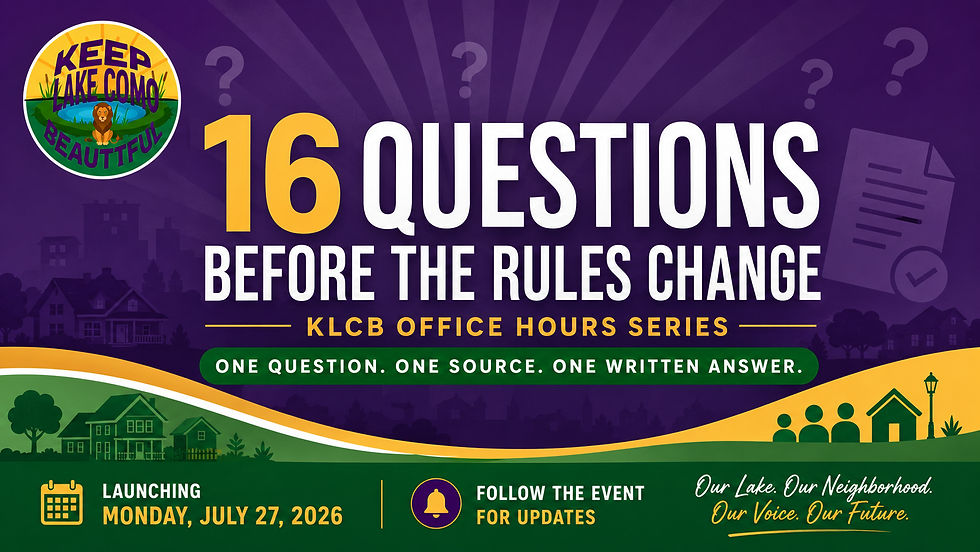
16 Questions Before the Rules Change
When rules change, residents need answers before decisions harden.
That is not being difficult.
That is being responsible.
If proposed standards may affect homes, repairs, additions, property use, affordability, development, investment, or future enforcement, residents deserve plain-language answers before being asked to support or live under those changes.
That is why KLCB developed 16 Questions Before the Rules Change.
The questions are not drama.
They are not busywork.
They are not resistance for the sake of resistance.
They are resident power in writing.
Before Lake Como is asked to move forward with new standards, residents should understand:
What is being proposed?
Who will be affected?
How will residents be notified?
What happens when someone needs to repair or improve their home?
How will affordability be protected?
What process exists for appeals or exceptions?
What parts are still unclear?
Where will public answers be preserved?
That is not negativity.
That is civic literacy.
And Lake Como deserves that.
The Block Needs Clarity Too
Office Hours S2E22 brought the same principle down to the curb.
Because block conditions can get messy fast.
Trash.
Bulk waste.
Dumping.
Vehicles.
Sidewalks.
Alleys.
Fences.
Right-of-way issues.
Vacant properties.
Repeat problem locations.
Resident need.
Property owner responsibility.
Outside dumping.
Those are not all the same issue.
And when we treat every condition like the same problem, we choose the wrong response.
That is how residents get frustrated.
That is how systems get clogged.
That is how neighbors feel attacked.
That is how real problems keep sitting there.
S2E22 was about slowing down long enough to name the condition correctly.
See it.
Name it.
Route it.
Save the receipt.
Follow through.
That is the WHUB rhythm.
That is Porch2Curb discipline.

Clear the Curb Como Is One Campaign
Clear the Curb Como is not the whole August issue.
It is one campaign inside the larger WHUB work.
But it is a strong example because the curb is where confusion shows up quickly.
The message is simple:
Not every pile is dumping. Every pile needs a plan.
Sometimes it is bulk waste.
Sometimes it is early.
Sometimes it is late.
Sometimes somebody missed the pickup window.
Sometimes a resident needs help.
Sometimes a landlord, contractor, or outsider is treating the block like a drop zone.
Sometimes it is both: a real need and a real mess.
That is why KLCB does not start with panic.
We start with the route.
Bulk Waste Has a Rhythm
Bulk waste has a monthly rhythm.
Pickup begins the fourth Monday of every month
.
The earliest residents can set items out is the Friday before at 6 PM.
That means the first question is not:
“Who did this?”
The first question is: Is this pile early, on time, late, unsafe, or dumped?
Same curb.
Different problem.
Different route.
That little bit of clarity matters.
Assistance. Accountability. Both.
When residents see a condition, the first move should not be drama.
The first move should be route selection.
Clear the Curb Como uses three routes:
Assistance. Accountability. Both.
That is the system.
Because everything does not need to start with a report.
And everything does not need to be excused either.
Some residents need help.
Some situations need accountability.
Some need both.
That is grown neighborhood work.
Route 1: Assistance
Some issues call for help first.
A resident may need the pickup schedule.
A household may need help moving something heavy.
An elder, renter, disabled resident, or busy household may need a reminder before the issue becomes a violation.
Assistance asks:
Does this household know the bulk waste rhythm?
Do they need help moving something?
Do they need a reminder?
Can this be solved respectfully before it becomes a case?
Everything does not have to begin with shame.
Sometimes the strongest block action is helping the problem get solved before it becomes bigger.
Route 2: Accountability
Some issues require documentation and follow-up.
If somebody dumps on a block where they do not live, that needs accountability.
If a property keeps creating the same problem, that needs accountability.
If a condition blocks access, creates safety concerns, attracts more dumping, or keeps returning, that needs documentation.
Accountability asks:
What happened?
Where did it happen?
When did it happen?
Is there a pattern?
What does the record show?
That is where photos, locations, report numbers, and follow-up matter.
Not because we want to be messy.
Because the block deserves better.
Route 3: Both
Sometimes both are true.
A resident may need help, and the block may still need the pile gone.
A property owner may need notice, and the issue may still need documentation.
A situation may deserve compassion, and the sidewalk may still need to be safe.
Both asks: How do we support the person and protect the block?
That is the middle lane too many conversations skip.
KLCB is not choosing between compassion and standards.
We need both.
This Is Bigger Than Trash
That is why this August issue is not just about trash.
Trash is one visible example.
The deeper issue is whether Lake Como residents have the tools to understand what is happening around them before they are asked to react.
Before rules change, residents need clarity.
Before residents report, they need clarity.
Before neighbors are blamed, residents need clarity.
Before a process moves forward, residents need clarity.
That is what KLCB is building through The Pride, Office Hours, 16 Questions, Porch2Curb, and block-level follow-through.
We are not just reacting.
We are building the habit of asking better questions.
What Residents Can Do This Month
Start with the issue that fits your lane.
Participate in 16 Questions Before the Rules Change
Before standards move forward, read the questions.
Understand what is being asked.
Track what answers come back.
Share it with a neighbor who owns, rents, repairs, improves, or cares about property in Lake Como.
Watch Office Hours S2E22
Use the episode to understand how KLCB is teaching residents to read block conditions without jumping straight to panic, blame, or confusion.
Choose a Porch2Curb Step
START HERE 💜🦁💛 → bit.ly/KLCBStart
📩 Block Subscriber
Stay informed + get tools and next steps. bit.ly/KLCBSubscribe
🗓️ 7-Day Challenge
The 7-Day Challenge helps residents practice the basics:
Notice the block.
Listen to neighbor voice.
Document what matters.
Choose the next step.

🏡 Adopt Your Block
Build a weekly rhythm and help shape what happens next. bit.ly/KLCBAdopt
The Bottom Line
Lake Como residents don't need to guess.
Not about rules.
Not about reports.
Not about the curb.
Not about who gets to decide what happens next.
Before rules change, residents need clarity.
Before conditions become conflict, residents need clarity.
Before concern becomes action, residents need clarity.
That is the work.
And that is why KLCB keeps showing up.

Comments